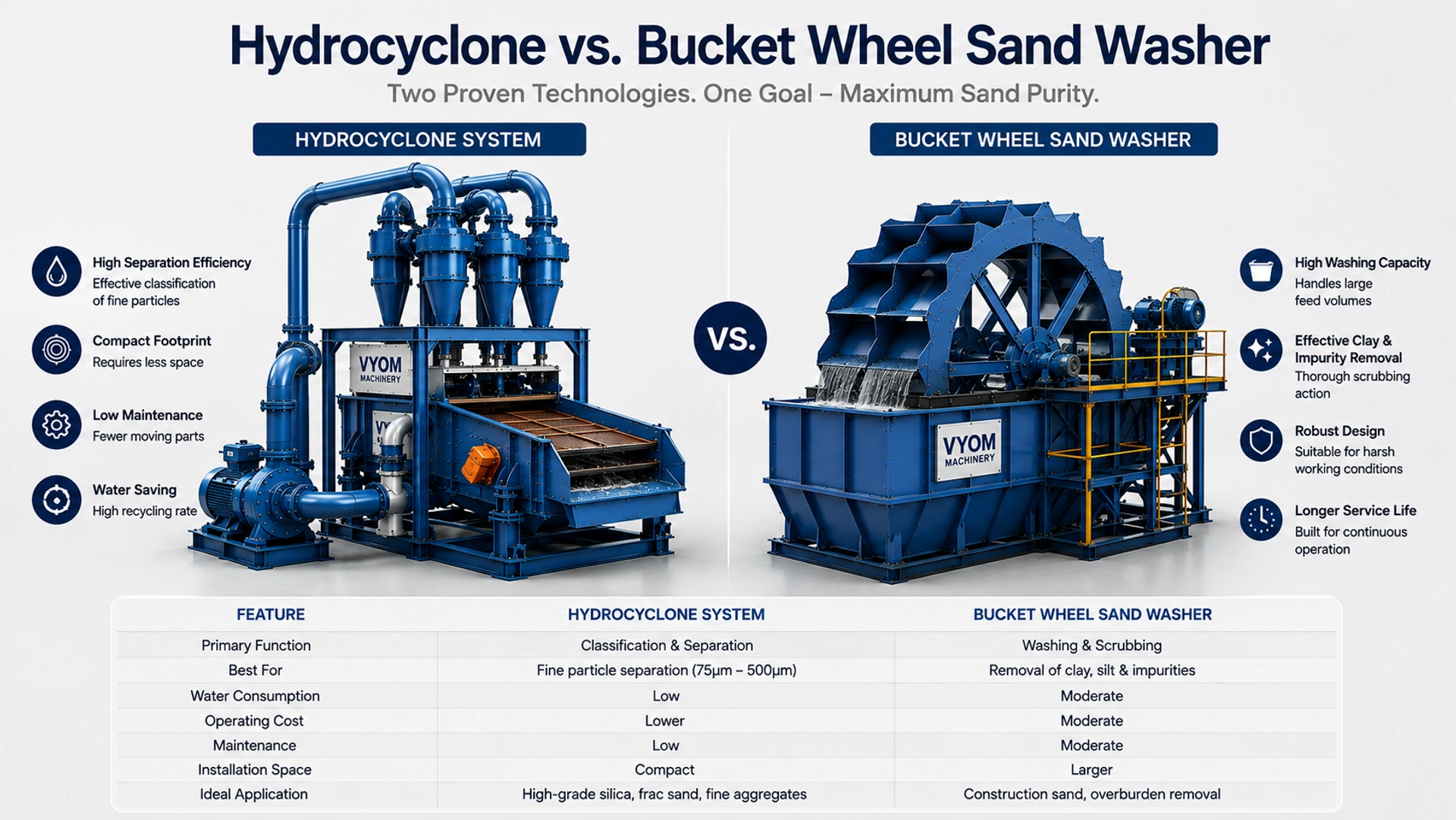
S electing the optimum sand washing mechanism is one of the most critical decisions facing quarry operators and mineral processing engineers. The washing technology directly governs final product purity, fine sand recovery efficiency, process water consumption, and overall plant profitability. Historically, the aggregate industry relied heavily on traditional Bucket Wheel Sand Washers. However, the rise of stringent concrete sand standards and modern hydrocyclone technology has reshaped industry benchmarks.
Traditional Bucket Wheel Sand Washers consist of a large revolving wheel fitted with perforated steel buckets dipping into a stationary water tank. As the wheel rotates slowly, buckets scoop sand from the bottom of the trough while water drains out through bucket perforations. While bucket wheels offer simple mechanical design, low drive power requirements, and low initial capital expenditure, their fundamental hydraulic mechanism suffers from severe technical limitations when processing fine aggregates and high-silt feeds.
The primary drawback of bucket wheel washers is their inability to capture fine sand particles between 75 and 150 microns. Because classification relies purely on gravity settling in an open, turbulent water bath, the high cross-flow water velocity necessary to float away silt also washes away vast quantities of valuable fine sand into tailing ponds. Operators routinely lose up to 15% to 25% of their total sand yield—representing millions of rupees in lost sellable tonnage annually, while simultaneously clogging downstream settling ponds with high-grade sand.
Conversely, Hydrocyclone Sand Washing Systems utilize pressurized fluid dynamics to achieve high-precision particle classification. Slurry is delivered by a rubber-lined centrifugal pump into the tangential inlet of a hydrocyclone at controlled pressures ranging from 0.8 to 1.5 bar. The rotational fluid motion generates intense centrifugal forces up to 100 times greater than gravity, driving dense sand particles outward toward the cyclone wall, where they spiral downward to discharge through the bottom apex spigot.
Meanwhile, light silt, clay micro-fines, and excess water are forced inward into a central vortex and discharged through the top overflow vortex finder. This dynamic pressure separation enables Vyom Hydrocyclones to capture up to 98% of valuable fine sand down to 75 microns. The dewatered underflow is then delivered onto a high-frequency polyurethane dewatering screen, reducing final product moisture content to under 10% to 12%—allowing sand to be loaded directly onto delivery trucks without long stockpile drying times.
From an operational ROI perspective, while a hydrocyclone system incurs higher initial pump power consumption compared to a bucket wheel, the financial return from recovering 15% to 20% additional fine sand far outweighs the electrical energy cost. Furthermore, hydrocyclones deliver a strictly controlled IS 383 grading zone and consistent Fineness Modulus that bucket wheels cannot replicate.
For modern quarry operations processing crushed M-Sand, silica quartz, or silt-heavy river deposits, Vyom Hydrocyclone Sand Washers represent the superior long-term engineering choice. For hybrid deposits, Vyom also manufactures combination Bucket-Cyclone plants that pair coarse bucket wheel washing with cyclone fine sand recovery, delivering maximum throughput and total resource utilization.