I n specialized industrial sand production—such as glassmaking silica, frac sand proppants, foundry molding sand, and filter bed media—mechanical screen decks fail to deliver sharp size separation below 1.0 mm. Woven wire screens and polyurethane decks with micro-apertures suffer from severe surface blinding, rapid wire wear, and low throughput capacity when attempting to screen fine sands at 0.15 mm to 0.6 mm. In this fine size spectrum, Hydraulic Classification via Hindered-Settling Density Hydrosizers provides the ultimate continuous sizing technology.
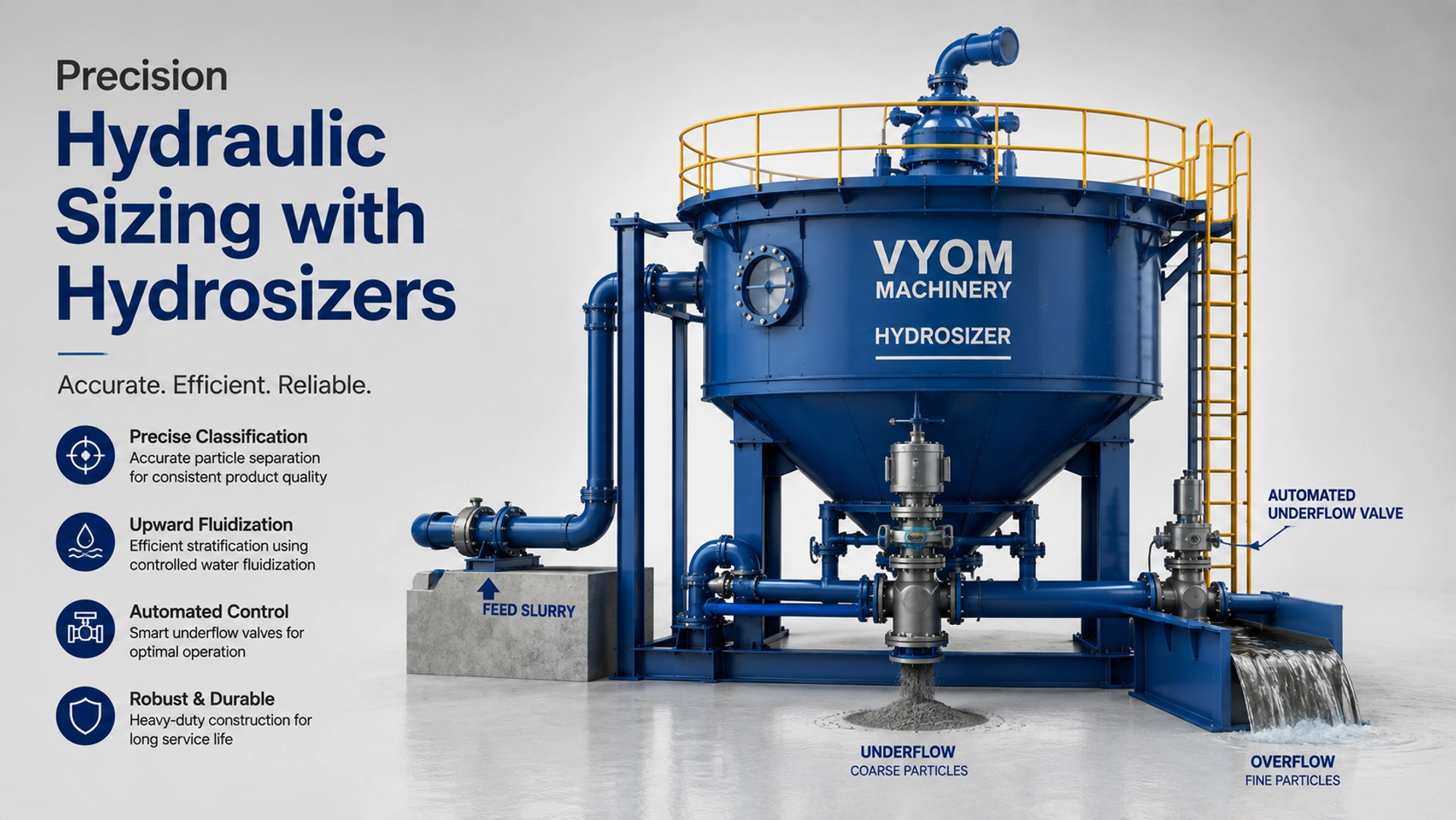
A Hydrosizer (also known as a Density Classifier or Teeter-Bed Separator) operates on the physical principle of hindered settling in an upward fluidized water bed. Raw sand slurry is introduced into the top feedwell of a vertical square or cylindrical vessel. Simultaneously, clean fluidization water is injected uniformly across the bottom of the vessel through a network of perforated distribution pipes or bubble-nozzles, creating a controlled upward hydraulic current.
As sand particles descend through the rising water column, they form a suspended, high-density zone known as a 'teeter-bed'. Within this teeter-bed, individual particle settling velocities are governed by Stokes' Law and hindered settling dynamics, where settling rates depend on particle mass, diameter, specific gravity, and the effective density of the surrounding fluid-solid suspension.
Coarser or denser particles overcome the upward fluidization velocity and settle toward the bottom cone of the vessel. Conversely, finer or lighter particles are unable to penetrate the high-density teeter-bed and are swept upward by the fluidization water, overflowing the top weir into the fine product launder. By precisely regulating the upward water flow rate and teeter-bed density, process engineers can establish a razor-sharp cut-point anywhere between 100 microns and 1000 microns.
Vyom Hydrosizers feature state-of-the-art automated density control loops. Differential pressure transmitters continuously measure the hydrostatic head across the teeter-bed zone, feeding real-time density data to a dedicated digital PID controller. When raw feed tonnage or particle grading fluctuates and the teeter-bed density rises above the setpoint, the controller automatically actuates a pneumatic underflow pinch valve, discharging coarse sand until target bed density is restored.
This continuous automated feedback loop ensures an exceptionally sharp separation curve (high Ecart Probable Imperfection, Ep value), eliminating misplaced fines in the coarse product and preventing coarse contamination in the fine fraction. Furthermore, Vyom Hydrosizers feature internal quiet zones and optimized water distribution manifolds to prevent turbulent eddy currents that could disrupt teeter-bed stability.
By incorporating Vyom Hydrosizers into multi-stage silica and mineral washing plants, mine operators can split broad sand feeds into multiple discrete, high-value size fractions simultaneously. Whether producing 30/50 mesh frac sand, 0.2 mm glass sand, or specialty filtration aggregates, hydraulic classification guarantees unmatched grading precision, maximum chemical purity, and continuous 24/7 processing reliability.