A cross the Indian infrastructure and construction sector, the rapid depletion of natural riverbeds and stringent environmental bans on river sand mining have established Manufactured Sand (M-Sand) as the primary fine aggregate for structural concrete. Produced by crushing hard granite, basalt, or limestone rocks using Vertical Shaft Impactors (VSI), raw M-Sand possesses high angularity and mechanical strength. However, unwashed crusher dust contains excessive micro-fines and silt fractions that compromise concrete performance if left unconditioned.
To ensure concrete structural integrity and durability, the Bureau of Indian Standards published IS 383:2016 ('Specification for Coarse and Fine Aggregates From Natural Sources for Concrete'). IS 383 categorizes fine aggregates into four distinct grading zones (Zone I, Zone II, Zone III, and Zone IV) based on particle size distribution passing through standard BIS sieves ranging from 4.75 mm down to 150 microns. For structural reinforced concrete (RCC) applications, Zone II and Zone III sands are universally specified by structural engineers and government tender boards.
The primary quality challenge in M-Sand manufacturing lies in managing the sub-75 micron fraction (silt and crusher dust slimes). IS 383 strictly caps the maximum allowable silt content in crushed stone sand at 7% by weight for unwashed aggregates and 3% to 5% for high-grade washing applications. Excessive micro-fines below 75 microns drastically increase the specific surface area of the aggregate mix, demanding significantly higher water and cement paste volumes to maintain concrete workability. This leads to increased drying shrinkage, surface cracking, and reduced 28-day compressive strength.
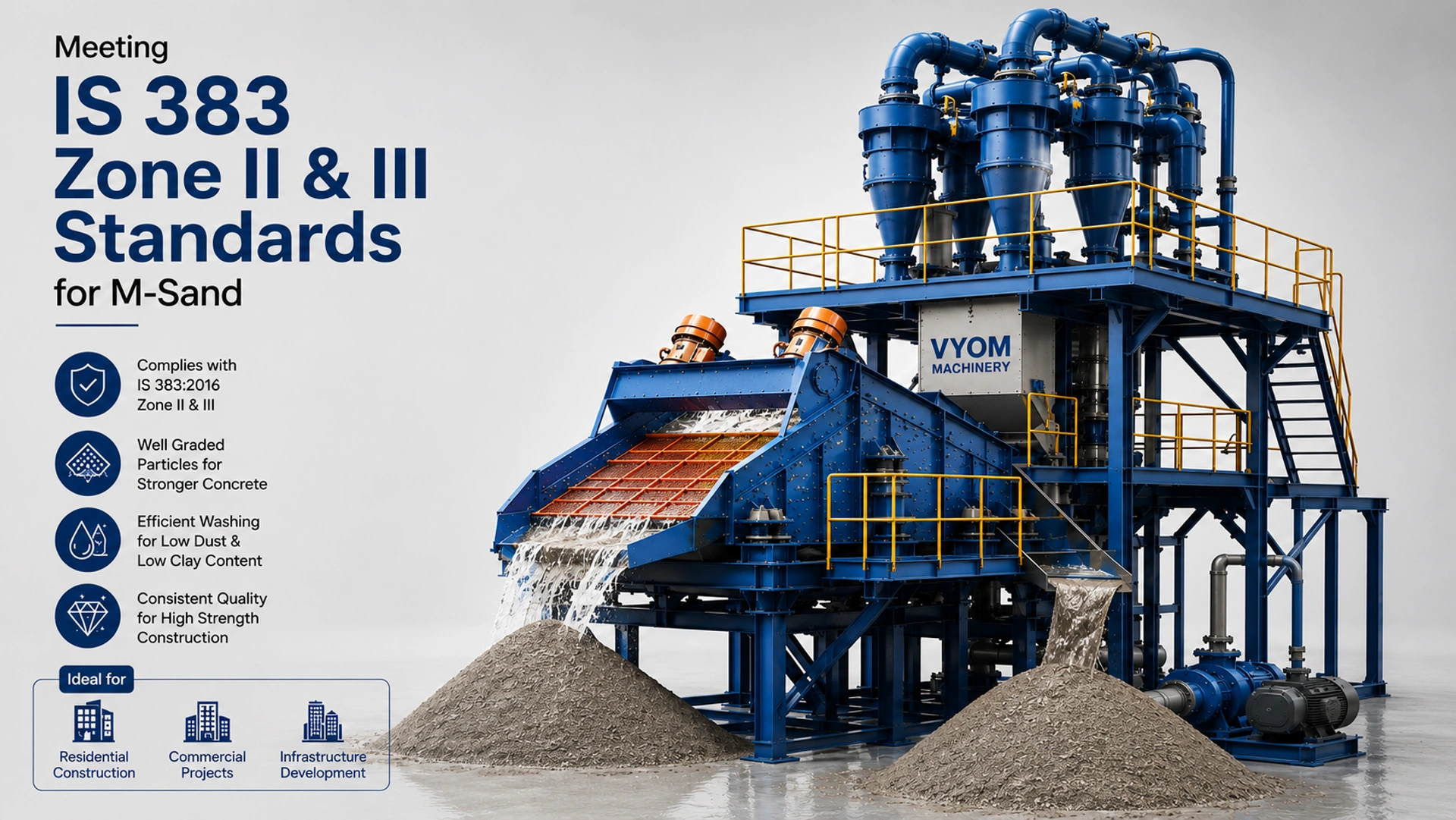
Vyom Hydrocyclone Sand Washing Systems provide the ultimate technical solution for precise IS 383 grading compliance. Unlike traditional bucket wheel washers that indiscriminately wash away valuable fine sand particles along with the silt, Vyom's engineered hydrocyclone circuits utilize centrifugal classification. By regulating slurry pump inlet pressure and hydrocyclone apex spigot geometry, the system establishes a razor-sharp cut-point at exactly 75 microns. Micro-fines below 75 microns are directed into the overflow stream, while 98% of essential 150 to 300 micron fines are retained in the washed product.
Controlling the Fineness Modulus (FM) is another vital aspect of IS 383 compliance. A consistent Fineness Modulus between 2.6 and 2.9 is ideal for Zone II concrete sand, providing optimum particle packing density and reduced void ratios. Vyom's automated dual-bucket sand washing configurations allow operators to blend coarse and fine sand fractions in real time, compensating for variations in raw quarry feed and crusher wear to maintain a steady FM target shift after shift.
By eliminating clay lumps, organic debris, and excess silt while maintaining optimum particle grading, washed M-Sand produced via Vyom hydrocyclone technology delivers superior concrete slump retention, improved pumpability for high-rise construction, and up to a 10% reduction in cement paste requirements per cubic meter of concrete. Mine operators achieve complete compliance with PWD, CPWD, NHAI, and Metro Rail tender specifications while maximizing product yield.
Investing in advanced IS 383 compliant M-Sand washing infrastructure ensures long-term operational viability for quarry owners. With automated quality monitoring, robust polyurethane dewatering screens, and low moisture discharge below 12%, Vyom M-Sand washing plants provide the consistency and reliability required by modern ready-mix concrete (RMC) producers and infrastructure mega-projects.